If you’ve been researching passive income ideas, you’ve probably asked yourself:
Is owning an ATM worth it in 2026?
The short answer: for the right location and setup, yes. The ATM business can still generate consistent monthly income with relatively low overhead. Even with electronic wallets and tap-to-pay options, cash withdrawal demand remains strong enough to support ATM revenue.
But like any investment, it depends on your costs, location strategy, and revenue model. Let’s break it down.
Is the ATM Business Profitable?
Yes, most ATM businesses generate profit after you cover startup and operational costs. Owning an ATM can be profitable when placed in a high-traffic location with strong transaction volume. Most ATMs generate income from surcharge fees, and additional services like Dynamic Currency Conversion (DCC) and crypto purchases can increase monthly revenue.
ATM profitability depends on three key factors:
- Monthly transaction volume
- Surcharge amount
- Operating costs
For example:
If an ATM processes:
- 250 transactions per month
- With a $3.00 surcharge
That’s $750 in gross monthly revenue from surcharge fees alone. Multiply that by multiple machines, and the model scales especially if the ATM is placed in a high-traffic location.
Unlike many service-based businesses, ATM machines don’t require staff, inventory, or inventory loss risk, keeping operating costs relatively low and making profitability more attainable.
Read more on How Do ATM Owners Get Paid? A Guide to ATM Ownership
How Does the ATM Business Model Work?
The ATM business model is simple: you own the machine, load it with cash, charge a surcharge per withdrawal, and keep most of the fee. Additional services like DCC and cryptocurrency sales can create extra revenue streams.
Here’s the simplified ATM business model explained:
- You purchase an ATM.
- You place it in a high-traffic location.
- Customers withdraw cash.
- You earn a surcharge fee per transaction.
- The machine settles funds automatically through a processor.
Revenue is predictable because it’s tied directly to transaction volume.
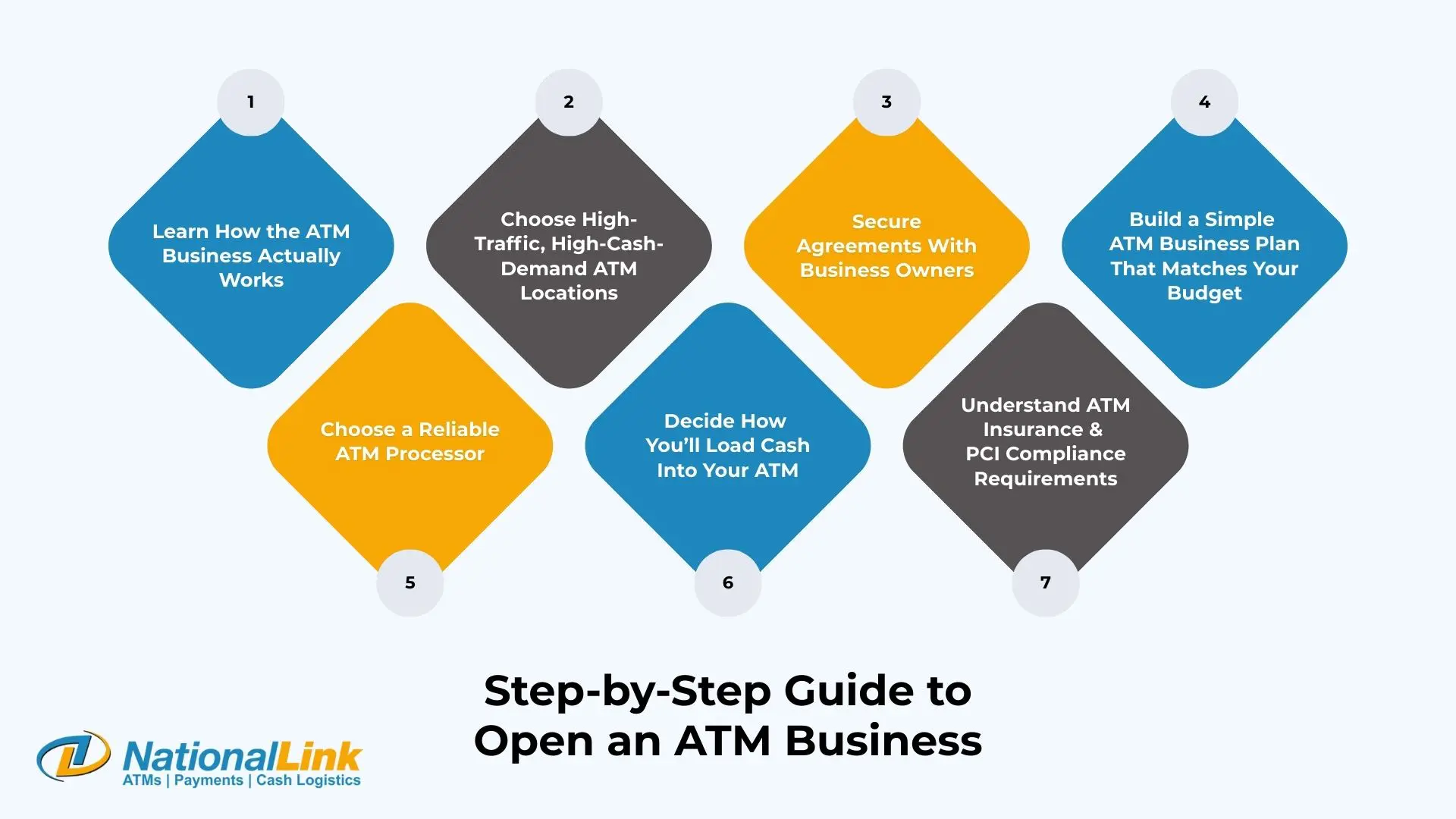
Read more on the Step-by-Step Guide to Open an ATM Business
Is Cash Still Relevant in 2026?
Despite digital payments gaining ground, cash remains a staple for many consumers, particularly in:
- Convenience stores
- Bars and nightclubs
- Casinos
- Gas stations
- Dispensaries or cash-heavy retail
Cash isn’t obsolete, and the reliability of ATM access keeps demand alive.
What Are the Startup Costs to Start an ATM Business?
Starting an ATM business typically costs between $2,500 and $8,000 per machine, depending on whether you buy new or refurbished equipment, plus cash loading and processing setup fees.
Typical startup expenses include:
- ATM machine: $2,000 – $5,000
- Installation and setup: $200 – $500
- Initial cash load: $5,000 – $20,000 (depending on the ATM model)
- Processing agreement
Compared to many brick-and-mortar businesses, startup costs are relatively low.
Read more on How Much Does It Cost to Start an ATM Business?
What Are the ATM Business Pros and Cons?
Pros of Owning an ATM
- Low operational overhead
- Predictable revenue model
- Scalable (add more machines)
- No employees required
- Works well as a semi-passive income
- Cash usage remains relevant despite digital trends
Cons of Owning an ATM
- Profits highly depend on location and foot traffic
- Cash management required
- Revenue share might be required with site owners
- Competition from bank ATMs and mobile banking exists
The biggest advantage is scalability. The biggest risk is poor location selection.
Read more on Can You Put an ATM Anywhere? A Guide to ATM Ownership
What Are the Risks of Owning an ATM?
The main risks of owning an ATM are low transaction volume, theft or vandalism, cash flow mismanagement, and regulatory compliance issues. However, these risks can be minimized with strategic placement and proper processing support.
Key risks to consider:
- Low-traffic location = fewer transactions
- Not negotiating revenue share correctly = more loss on your end
- Poor cash forecasting = messes up your cash flow
- Lack of value-added services = lose customers to nearby ATMs that provide such services
- Inadequate maintenance and compliance = security risks
Most risks are operational, not market-based, so you can effectively mitigate the risks.
How Long Does It Take to Break Even?
Most ATM owners break even within 6 to 18 months, depending on transaction volume and startup costs. High-performing locations can recover initial investment even faster.
Example:
- Spend $5,000 on an ATM
- Earn $500–$1,200+ per month
- Break-even occurs within the first year
- After break-even, most surcharge revenue becomes profit.
What Impacts ATM Investment Return?
Your ATM investment return depends on:
- Transaction volume
- Surcharge amount
- Revenue-sharing agreements
- Cash handling efficiency
- Value-added services activation
Adding services like:
- Dynamic Currency Conversion (DCC)
- Dual Balance inquiries
- LibertyX cryptocurrency sales
- On-screen advertising
can increase revenue per transaction. This is where many new ATM owners leave money on the table.
Is the ATM Business Passive Income?
The ATM business is semi-passive income. While it requires cash loading, monitoring, and occasional maintenance, it does not require daily staffing or active selling.
If you outsource:
- Cash loading
- Maintenance
- Monitoring
It becomes even more passive, but it also reduces margins.
Who Should Start an ATM Business?
Owning an ATM is often a good fit for:
- Entrepreneurs seeking recurring income
- Retail store owners
- Owners of high-risk businesses like casinos and cannabis dispensaries
- Bar or nightclub operators
- Mom-and-pop restaurants and cafes owners
- Laundromat owners
- Investors looking to diversify
It works especially well in cash-heavy environments.
Read more on Top 10 Cash-Only Businesses for ATM Placement
So, Is Owning an ATM Worth It in 2026?
Yes, owning an ATM is worth it in 2026 if you secure a high-traffic location, manage cash efficiently, and activate additional revenue features beyond basic surcharge fees.
Cash usage may fluctuate, but it has not disappeared. For many small and aspiring business owners, the ATM business remains one of the simplest recurring revenue models available. When structured properly, owning an ATM can generate steady monthly income with manageable risk and scalable growth potential.
Have more questions about ATM Business? Contact NationalLink today to find the solutions to your questions.