

Suppose you’re looking for a low-maintenance, recession-proof side business (or full-time business) with real passive income potential. In that case, opening an ATM business is one of the smartest investments you can make.
Most people don’t realize this, but nearly half of all ATMs in the U.S. are owned by independent operators, not banks. These operators are called IADs (Independent ATM Deployers). They earn income every time someone withdraws cash from their machine.
And the best part?
An ATM business is a passive-income model where you own or host an ATM machine and earn money every time someone withdraws cash.
You make revenue from:
The ATM industry continues to grow due to cash-reliant businesses such as convenience stores, salons, nightclubs, gas stations, dispensaries, and small retailers. With low operating costs and predictable revenue, owning an ATM is one of the highest-ROI side businesses today.
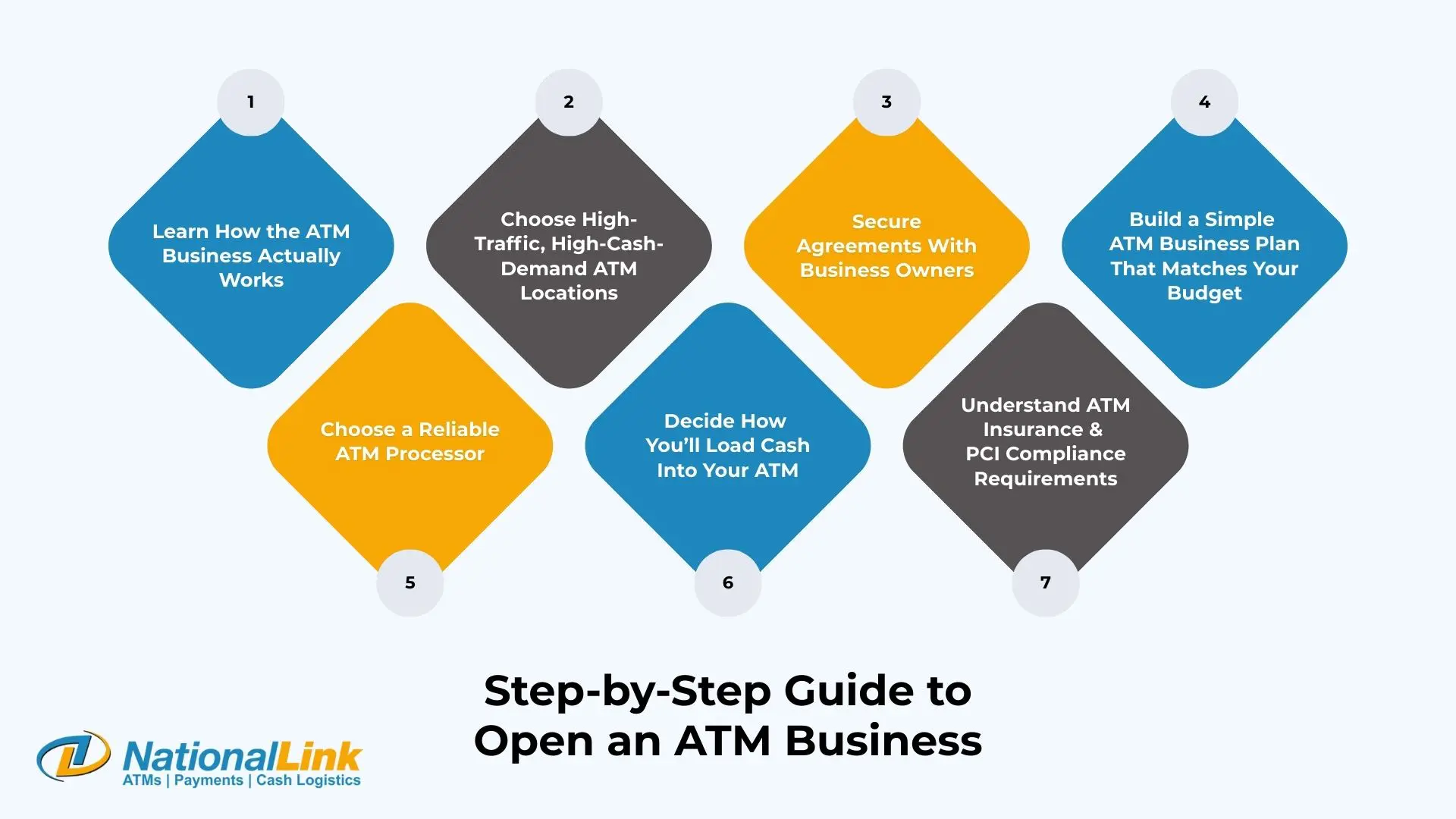
If you’re ready to learn how to start an ATM business (and avoid the expensive mistakes beginners make), this guide walks you through everything step-by-step.
Many new operators get excited and buy the cheapest ATM they can find online, only to discover later that it’s not compliant, not upgradeable, or not connected to the right processor.
Instead, start by understanding the basics:
You earn a surcharge fee every time someone withdraws cash.
Typical surcharge: $2.50–$4.00 per withdrawal
Typical transactions: 150–300 per month in good locations
That’s $375–$900 per month per ATM, often higher in cash-heavy locations.
For a deeper breakdown of revenue, cash loading requirements, and ROI, read: How Do ATM Owners Get Paid?
You don’t need a full course to start, but you DO need a real, reputable ATM partner (which is exactly what NationalLink is).
Location will make or break your ATM business.
A machine in a slow retail shop might earn $80/month.
A machine in a busy, cash-preferred location can earn $ 800 or more.
Cash-only businesses are excellent locations for opening ATM machine business.
Some of the most profitable ATM placements today come from:
Mobile ATMs and ATM trailers perform extremely well at these temporary sites.
Your strongest resource: Can You Put an ATM Anywhere?
Walking into a location and asking, “Would you like a free ATM that brings more foot traffic and reduces credit-card fees?” is often all it takes.
But before signing anything, check:
Pro tip: Always offer the business owner a revenue share. It helps secure long-term relationships.
You don’t need a 20-page document. You just need clarity on:
Total cost to start: $3,000–$5,000 on average.
You can fund your first machine using:
Your ATM pays for itself quickly in a good placement.
Your ATM processor handles:
A bad processor = slow payments, poor support, and potential compliance headaches.
A great processor (like NationalLink) =
Before choosing a processor, read: Choosing an ATM Processor: What IADs Need to Know
There are 2 ways to load cash into your ATM (otherwise known as Vaulting):
Best for small businesses or side-hustlers who want to keep 100% of profits.
You typically:
If you prefer full outsourcing, NationalLink offers a Vault Cash & Armored Service Program that handles everything:
This option is ideal for high-traffic ATMs or owners who don’t want the responsibility of handling cash.
Everything is insured, monitored, and documented.
→ For more details: Who Fills Money In ATM Machines
You don’t need expensive “ATM insurance” to operate safely.
Instead, your main protections are:
Full ATM theft is extremely rare, but physical damage can still occur so choose your locations wisely.
PCI DSS compliance ensures cardholder data is protected. ATM owners must:
NationalLink handles PCI compliance for all machines we install, ensuring secure transaction processing.
And with the right partner, you’re not doing it alone.
NationalLink has helped thousands of new ATM owners start and scale their ATM routes with:
Contact NationalLink today to get a free consultation and learn how to open your ATM business today.
Sales Desk: (877) 286-4242
Help Desk: (800) 363-9835
Account Services: (909) 670-1900 x117



NationalLink Inc.
Proud member since 1999
We are also members of all regional & interbank card networks, including Pulse & Star
NationalLink is sponsored by MetaBank and is a banking partner of US Bank and WSFS Bank. NationalLink is a registered ISO with Chesapeake Bank, Virginia. Copyright © 2026 NationalLink Inc. Privacy Policy | Terms of Use | Sitemap | Contact Us